Maths tutoring for ages 6–16
Maths here follows your child’s own curriculum rather than a generic syllabus. You choose the framework (US, UK National Curriculum, Australian Curriculum or CBSE) and the class is taught to that grade’s content, using that country’s terms. The core track runs twice a week across the school year; SAT preparation and Algebra Mastery are shorter, focused courses for older students.
A closer look
How math is taught here
How a maths class runs
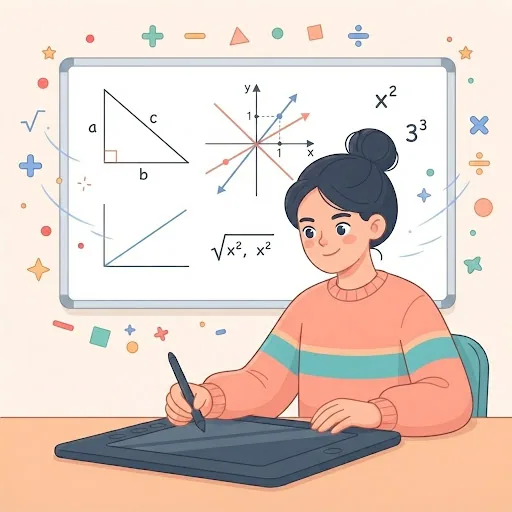
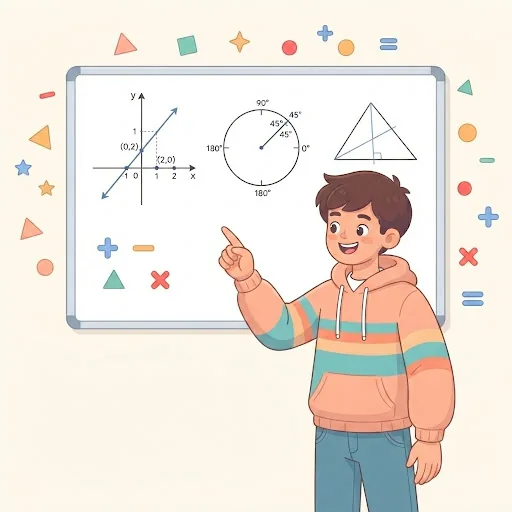
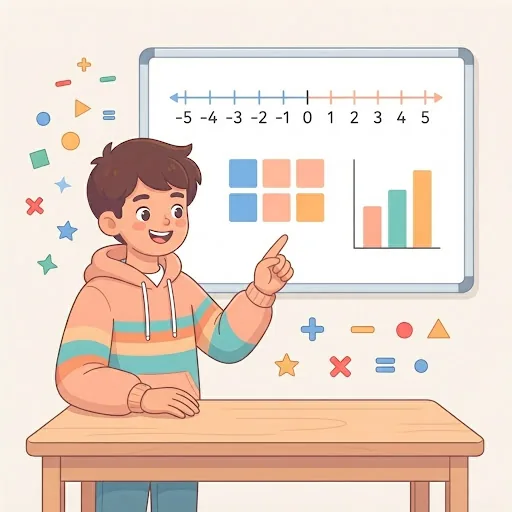
The instructor works on a shared whiteboard, and students work on paper and show their method, not only the answer. Most of the class is spent solving, not watching.
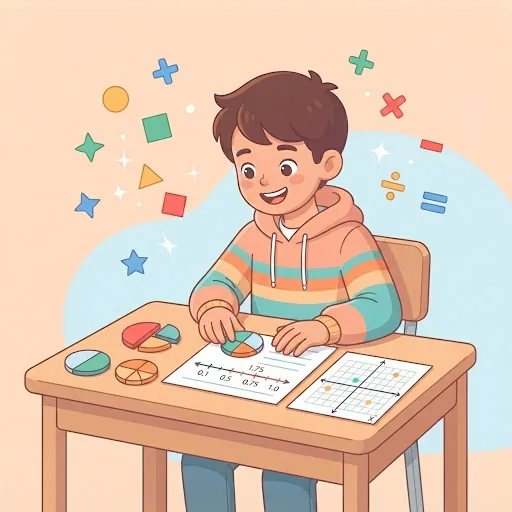
A child who only watches a worked example learns how it looks, not how to do it. So every new method is followed straight away by a question the child does themselves, and the instructor looks at how they got there before moving on.
Which curriculum, in which country
United States: grades and topics follow the US grade sequence. Most states use Common Core or standards adapted from it. Texas, Virginia, Florida and a handful of others have their own, but the grade-level topics overlap heavily. If your school teaches in a different order, tell the instructor and the class follows it.
Australia: the course follows the Australian Curriculum and uses Year levels. NSW teaches the same content through its own syllabus, organised in Stages, and Victoria uses the Victorian Curriculum 2.0. The mathematics is close to identical, and that includes the NAPLAN numeracy years (3, 5, 7 and 9), where the same skills are tested.
United Kingdom: the National Curriculum by Year group, through Key Stages 2 and 3 and into early GCSE content. India: CBSE by Class.
What gets covered at each age
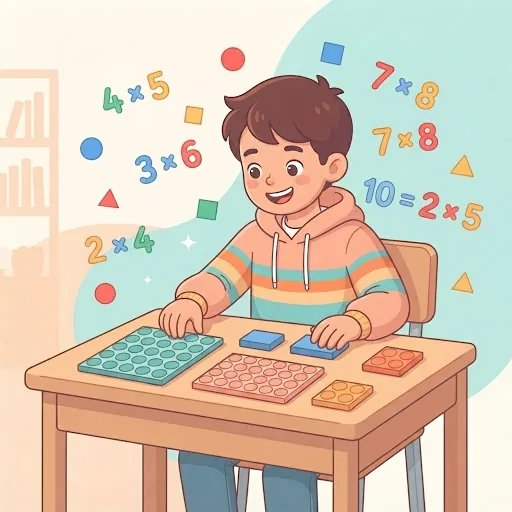
Ages 6–10 (US Grades 3–4, AU and UK Years 3–5; the course starts at Grade 3 content, and a 6- or 7-year-old who is ready for it can join there): times tables until they are automatic, multi-digit arithmetic, what multiplication and division mean, and first fractions on a number line, not only as pizza slices.
Ages 10–12 (US Grades 5–6, Years 6–7): fractions, decimals and percentages as three ways of writing the same number, ratio, and first steps into algebra through patterns. This is where many children decide they are "bad at maths", and usually it is one gap in fractions talking.
Ages 12–14 (US Grades 7–8, Years 8–9): negative numbers, linear equations, straight-line graphs, angles, area, volume and probability. Algebra stops being a separate topic and becomes the language the rest of maths is written in.
How progress shows up
The most reliable sign is not a test score. It is a child who attempts a question they have not seen before instead of waiting to be shown.
Instructors also watch for the mistakes a child repeats. A repeated mistake almost always points to one missing idea rather than general weakness, and fixing that one idea moves everything after it.
Online, compared with a local tutor
The maths is the same. What changes is logistics and choice: no driving, more times to pick from, and a parent can sit in.
The trade-off is a computer and a quiet space, with paper alongside the screen. If you are weighing a small group against a private tutor, our guide on group versus 1-on-1 tutoring sets out who does better in each.
Find the right math class
Not sure which level fits your child? Tell us their age and what they have done so far, and we will point you to the right class.
Reviews
What families say
“The instructor is very patient.”
Outcomes
What your child will be able to do
- Work at the level your child is actually at, not the level their year group is supposed to be at
- Fill the specific gaps that make later topics feel impossible — usually fractions, then algebra
- Sit an exam question and know which method it is asking for, before starting to calculate
- For SAT students: timed practice on the real question formats, with worked strategies
Checklist
What you need before the first class
Tick these off and your child is ready.
- A computer or laptop — the tools we teach with do not run properly on a phone
- Paper and a pencil. Maths still gets worked by hand in class
- For SAT Math and Algebra Mastery, a comfortable grounding in arithmetic first
FAQ
Questions parents ask
- ?Which curriculum do you teach?
- Whichever one your child is in: US, UK, Australian or CBSE, using that framework’s own level names (Grade 7, Year 7 or Class 7). The "Your curriculum" tab above shows how it maps by country and state.
- ?My child is behind. Do they join their age group?
- No. Classes are chosen by what a child can currently do, not by age. Placing a struggling student in their nominal grade is the most reliable way to make them stop trying.
- ?How much does a class cost?
- A group class is $11 and a 1-on-1 class is $16, priced per class rather than as a subscription. See the pricing page for the full breakdown.
Guides for parents