
Parent guide · 6 min read
Multi-step equations for kids: what to do when x is on both sides
One-step equations such as x + 4 = 9 are easy to do by instinct. Two-step equations, and then equations with x on both sides like 5x + 4 = 2x + 19, are where children start to lose their footing, because instinct stops working and a method has to take over. The method is short and it never changes: whatever you do to one side of the equals sign, you do to the other, and you do it until x is alone. Most errors come from skipping that rule on a negative number or on a bracket.
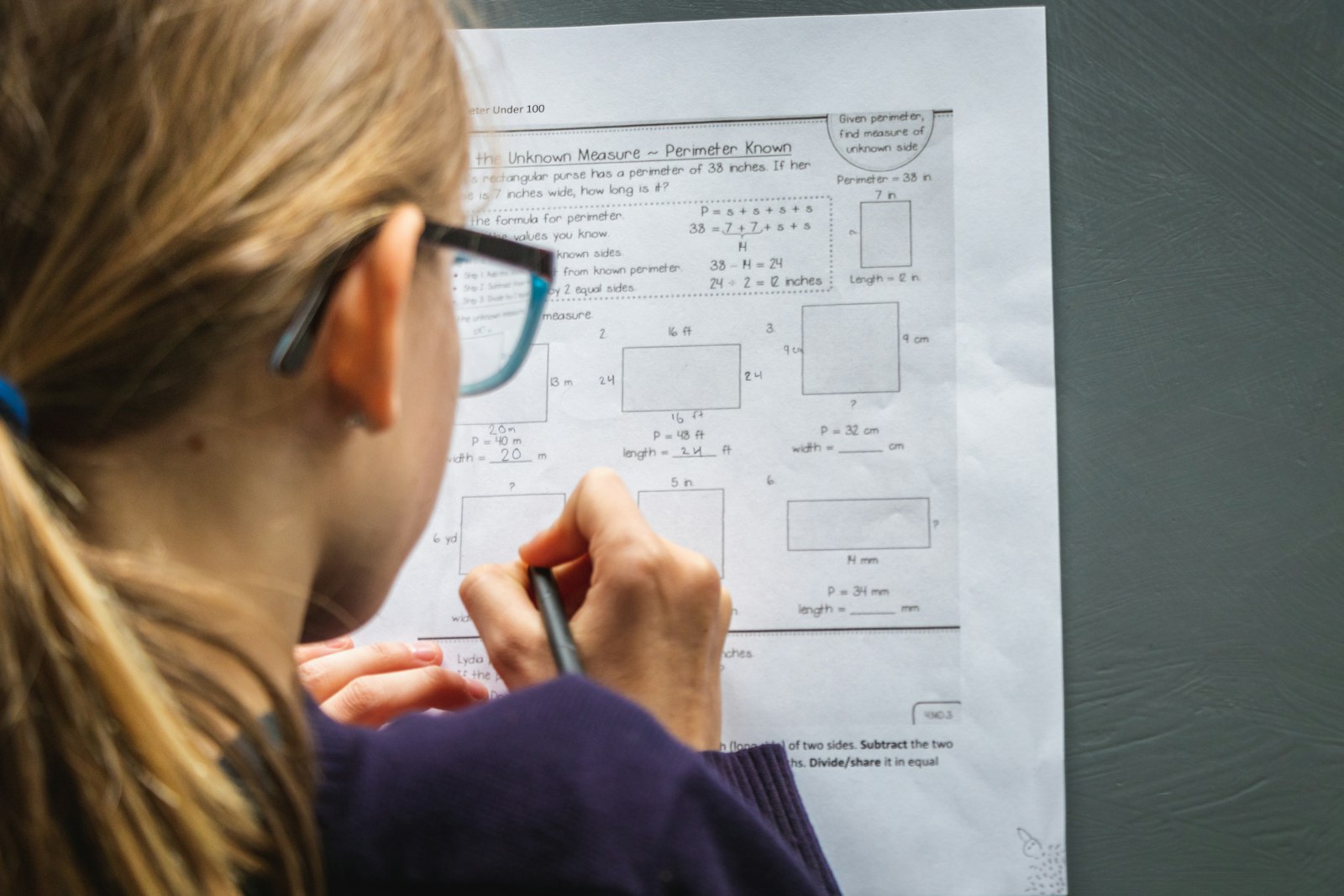
Try this tonight
5 things you can do at home
Say the rule out loud: "same thing to both sides"
Treat the equals sign as a balance. If a child subtracts 2x from the left, they must subtract 2x from the right. Writing the operation in the margin next to each line ("− 2x", "− 4", "÷ 3") makes it visible and easy to review.
Tidy each side before moving anything
Open brackets and combine terms that match on each side first. In 4x + 2 + x = 3x + 12, the left side becomes 5x + 2 before any moving starts. Skipping this step is the usual cause of an equation that seems to have too many parts.
Move the x terms to one side, then the plain numbers to the other
Subtract the smaller x term from both sides so the x count stays positive, then add or subtract the plain number. Working in this order, always x terms first, gives a child one routine for every equation.
Undo the multiplier last
Once the equation looks like 3x = 15, divide both sides by the number in front of x. Dividing last, after the adding and subtracting, matches the reverse of the order in which the equation was built.
Check by substituting into the original
Replace x with the answer in the equation as first written and make sure both sides come out equal. Doing this takes under a minute and catches sign slips that no amount of re-reading will.
Why the order works: undoing the equation in reverse
An equation like 3x + 5 = 20 says "multiply x by 3, then add 5, and you get 20". To find x, undo those operations in the opposite order: take away the 5 first, then divide by 3. That gives 3x = 15 and then x = 5. The same thinking carries through longer equations, because each step peels off one layer.
When x appears on both sides, there is one extra job at the start: gather the x terms together so that x appears once. After that, the equation is a two-step equation again, and the earlier method applies unchanged.
Worked examples: x on both sides, then a negative answer
Solve 5x + 4 = 2x + 19. Subtract 2x from both sides: 3x + 4 = 19. Subtract 4 from both sides: 3x = 15. Divide by 3: x = 5. Check in the original: the left side is 5 × 5 + 4 = 29 and the right side is 2 × 5 + 19 = 29, so both sides match.
Solve 3x − 7 = 5x + 1. Subtract 3x from both sides: −7 = 2x + 1. Subtract 1 from both sides: −8 = 2x. Divide by 2: x = −4. Check: the left side is 3 × (−4) − 7 = −19 and the right side is 5 × (−4) + 1 = −19. Moving the smaller x term (3x) left a positive 2x; moving the larger one would also work, but it produces −2x, and that is where sign slips creep in.
Brackets, and the equation with no solution
Solve 2(x + 3) = 14. Open the bracket by multiplying both parts: 2x + 6 = 14. Subtract 6: 2x = 8. Divide by 2: x = 4. The slip to watch for is writing 2x + 3 and forgetting to multiply the 3 as well. A child who divides both sides by 2 first, to get x + 3 = 7, also reaches x = 4, which is a good way to confirm the answer.
Some equations have no solution. In 2x + 3 = 2x + 7, subtracting 2x from both sides leaves 3 = 7, which is never true, so no value of x works. If subtracting leaves something that is always true, such as 3 = 3, then every value of x works. A child who meets either result for the first time often assumes they have made an arithmetic error, so it is worth showing one example of each.
Signs it’s time for outside help
When home help has done what it can
- Does the operation on one side of the equals sign but not the other.
- Gets the right method but loses a minus sign when moving a term.
- Forgets to multiply every term inside a bracket.
- Cannot say why a step is allowed, only that "the teacher said to".
- Never substitutes the answer back to check it.
- Freezes when x ends up on the right-hand side, or the answer is negative or a fraction.
Questions parents ask
FAQ
What age do children usually learn multi-step equations?
Two-step equations usually appear around ages 11–13, and equations with x on both sides around ages 12–14 (US Grades 7–8, Australian Years 7–8, England Key Stage 3).
Should x always end up on the left?
No. x = 5 and 5 = x are the same statement. What matters is that x is on its own on one side, and it is fine for the answer to finish on either side.
Which side should the x terms move to?
Either works. Moving the smaller x term keeps the x coefficient positive, which avoids most sign slips, so it is a good default for a child who is still building confidence.
What if the answer is a fraction or a decimal?
That is allowed and common. For 4x + 1 = 10, x = 9/4, which is 2.25. Checking in the original equation works the same way, so a fraction answer is not a sign of a mistake.
Further reading
Classes that fit
Live, 50–60 minutes, four learners at most or 1-on-1.
Not sure which is right for your child?
Tell us their age and what they have tried so far, and we will suggest where to start before you book anything.