
Parent guide · 5 min read
Pre-algebra for kids: what it covers and what grade it starts
Pre-algebra is one of those school terms that parents hear without anyone saying exactly what it means. It is not a separate branch of maths. It is the bridge year, or two, where arithmetic starts turning into algebra: fractions and negative numbers become routine, letters begin to stand for unknown numbers, and ratios turn into equations. This guide explains what it covers, when it usually happens, and how to tell whether your child is ready to cross over.
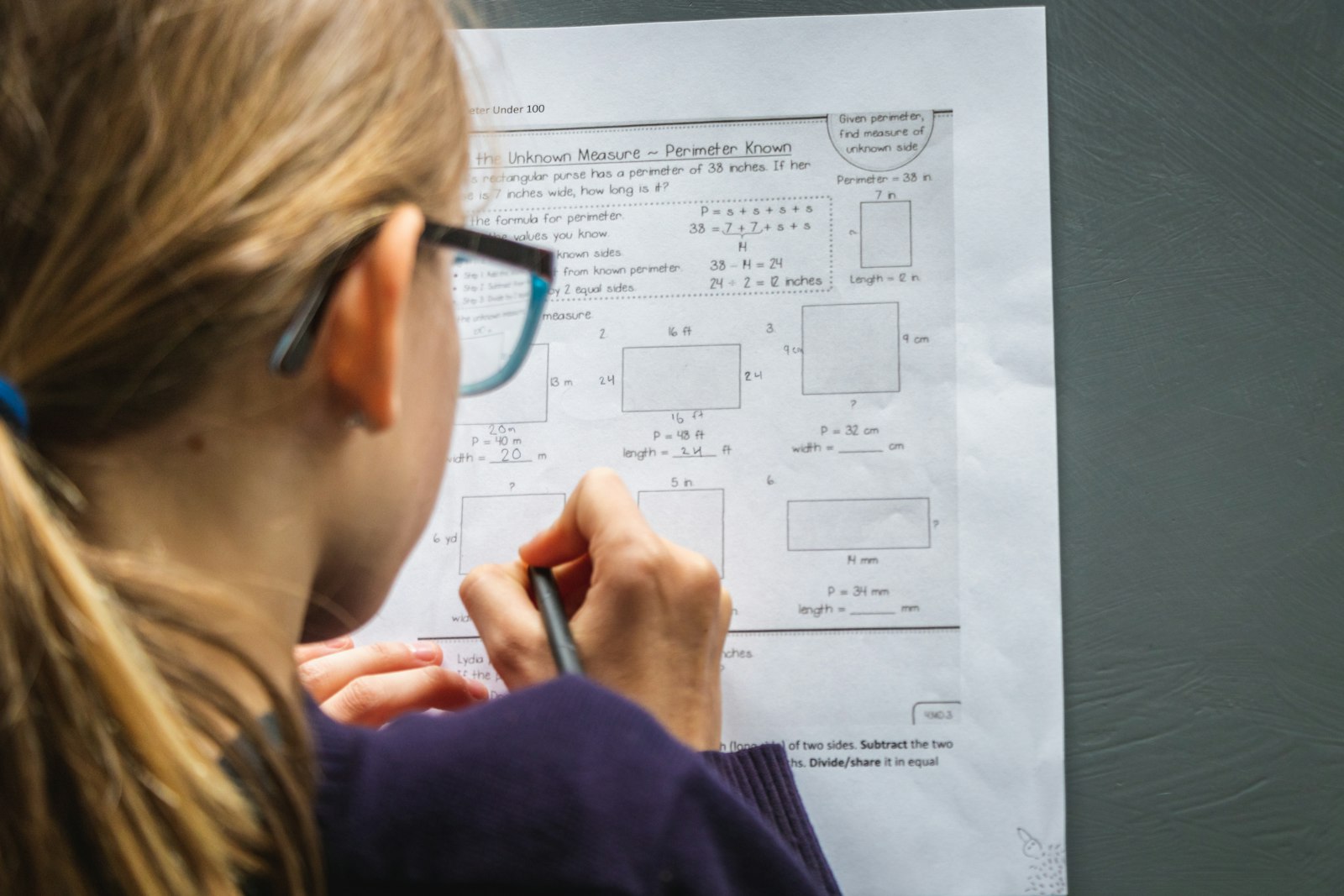
Try this tonight
4 things you can do at home
Give a five-question fraction and negative-number check
Try 3/4 × 2/3, 5/6 ÷ 1/2, −4 + 9, 3 − 8 and −2 × −5, with no calculator. Hesitation or errors here are the most common reason algebra later feels harder than it should, so it is better to find them now than in the middle of an equations unit.
Ask what a letter in an equation stands for
Write n + 6 = 15 and ask what n means and how they would find it. A child who says "it is the number that makes the sentence true, so 9" is ready. A child who sees a mystery symbol needs a few more examples with a missing box before letters are introduced.
Turn a real ratio into an equation
A recipe uses 2 cups of flour for 12 muffins. How much for 30? Let your child set it up as 2/12 = x/30 or as "1 cup makes 6, so 5 cups make 30". Pre-algebra rewards setting up the relationship, not just getting the number.
Check whether they do the same thing to both sides
Ask them to solve 2x + 3 = 11 and say each step aloud. The key habit is "whatever I do to one side I do to the other". If they only guess and check, that works for small numbers but breaks as soon as the answer is a fraction.
What grade is pre-algebra?
There is no single national answer. In many US schools pre-algebra is a Grade 7 course, with algebra 1 in Grade 8 or 9. Schools that accelerate students may teach it in Grade 6, and some teach it in Grade 8 before a Grade 9 algebra course. In Australia the same material falls across Years 7 and 8 and is simply part of the general maths course rather than a named subject.
Because of that, a better question than "what grade" is "which skills". If your child can work confidently with fractions, negative numbers, ratios and simple equations, they are doing pre-algebra whatever the course is called.
The five skills pre-algebra builds
Number fluency comes first: all four operations on fractions, decimals and integers, including negatives. Next is ratio and percent work, where a relationship such as "3 for every 5" is used to scale a quantity up or down. Third is expressions, where a statement like "three more than twice a number" is written as 2n + 3 and simplified. Fourth is equations, where one- and two-step equations are solved by undoing operations on both sides. Fifth is early graphing and patterns, where a table of values is read as a rule.
None of these is brand new in itself, which is why pre-algebra can feel like a continuation. What is new is the habit of writing the relationship down with a letter instead of working out one answer at a time.
A worked example: from a word problem to an equation
A gym charges a $15 sign-up fee plus $8 per visit. Alexa has spent $63 in total. How many visits did she make? Arithmetic can solve it by trial, but pre-algebra writes it down: 15 + 8v = 63.
Undo the fee first by subtracting 15 from both sides: 8v = 48. Then undo the multiplication by dividing both sides by 8: v = 6. Check it in the original sentence: 15 + 8 × 6 = 63. The skill being practised is not the arithmetic, which is easy here, but the move from a sentence to an equation and the habit of checking the answer against the story.
Signs it’s time for outside help
When home help has done what it can
- Fraction or negative-number mistakes keep appearing in work that is otherwise about something else.
- Your child can solve an equation by guessing but cannot explain what they did.
- Word problems are skipped or answered with a number that does not fit the story.
- A letter in a problem is treated as a label ("x for apples") rather than as a number.
- Homework that used to take 20 minutes now takes an hour and ends in frustration.
Questions parents ask
FAQ
Is pre-algebra the same as algebra 1?
No. Pre-algebra prepares for algebra 1. It works mostly with numbers, ratios and one- and two-step equations, while algebra 1 goes on to graphing lines, systems of equations and quadratics.
Can my child skip pre-algebra?
Some schools let strong students go straight to algebra 1, but it works only when fractions, negatives, ratios and basic equations are already secure. Skipping with gaps usually shows up later as a struggle in algebra.
What if my child is behind in fractions?
Fix that first. Pre-algebra assumes fraction fluency, and extra equation practice will not make up for it. A few weeks on fraction operations usually does more than doing the pre-algebra worksheet again.
Are pre-algebra worksheets enough?
They are useful for practice once your child understands the idea, but worksheets alone do not show why a step works. Pair them with explaining one problem aloud each day.
Further reading
Classes that fit
Live, 50–60 minutes, four learners at most or 1-on-1.
Not sure which is right for your child?
Tell us their age and what they have tried so far, and we will suggest where to start before you book anything.