
Parent guide · 7 min read
Year 7 maths: what changes and where kids get stuck
Year 6 to Year 7 is usually the biggest jump in primary-to-secondary maths, and it rarely announces itself as one. It looks like more homework and a new teacher, but underneath that, several topics that were previously introduced gently — negative numbers, letters standing for unknown values, ratio — become topics a child is expected to actually use, in the same term, alongside everything from Year 6 that is assumed to already be solid. This guide sets out what genuinely changes, and where that change tends to trip a child up.

Try this tonight
5 things you can do at home
Ask your child to explain what a pronumeral is, in their own words
If they can only say "a letter", ask what it stands for in a specific example, like x + 3 = 7. The idea that a letter represents a specific missing number — not a mystery symbol — is the one shift that Year 7 algebra rests on.
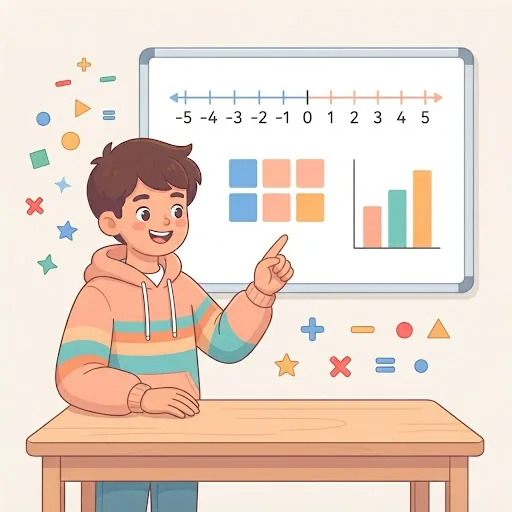
Try one negative-number problem together, with a number line
Draw a simple number line and ask your child to work out 3 − 7, then −2 + 5. Errors here almost always come from treating the minus sign as an instruction ("go down") rather than understanding what a negative number actually represents.
Check whether a ratio is being read as a fraction
Ask your child what a 2:3 ratio of cordial to water means for a jug of 500 mL. A child who has only learned fractions often tries to treat "2:3" as "2 out of 3", rather than as two quantities being compared, and gets a confidently wrong answer.
Revisit any shaky Year 6 fraction or decimal skill directly
Year 7 does not slow down to re-teach fraction or decimal arithmetic; it assumes it and builds algebra and ratio work directly on top. A few minutes spent confirming your child can multiply and divide fractions confidently now saves a much bigger gap appearing later in the term.
Ask what topic changed most since last term, and why it felt different
This tells you, in your child’s own words, which of the shifts above (numbers going negative, letters standing for values, ratios as relationships) is the one actually causing trouble right now, rather than guessing from the outside.
Why Year 7 feels like a bigger jump than Year 6 did
Most primary years deepen one or two strands at a time: more digits in Year 4’s arithmetic, more fraction operations in Year 5 and 6. Year 7 instead opens several strands at once — number (negative integers, index notation), algebra (pronumerals, simple equations), and ratio and rate — each of which needs the last few years of number sense to already be solid, because none of them are re-taught from scratch.
That combination is what makes the year feel harder than the topics look individually. A child who is confident with fractions but shaky on negative numbers can suddenly seem to be struggling with "algebra", when the actual gap is a few years further back, in a different topic that Year 7 is quietly assuming is already fixed.
Negative numbers stop being an edge case
In primary school, negative numbers usually appear briefly, often just as "numbers below zero" on a thermometer or a number line. In Year 7 they become numbers to calculate with directly: adding, subtracting, multiplying and dividing them, and mixing them into the same working as positive numbers.
The common mistake is treating a minus sign as a direction rather than a value: a child asked to compute 3 − 7 will often correctly get −4 by counting down on a number line, but the same child asked to compute −2 + 5 sometimes cannot tell which way to move, because there is no longer a single "start" number the subtraction makes obvious. Practising both directions on a number line, not just counting down, is what actually fixes this.
A worked example: ratio versus fraction
A recipe uses flour and sugar in a ratio of 3:2. A child who has only strongly learned fractions often reads this as "3 out of 2" or "flour is three-fifths of the mixture" without checking — both wrong ways to use the numbers. The correct approach: 3:2 means for every 3 parts flour there are 2 parts sugar, so the mixture is split into 3 + 2 = 5 equal parts in total, and flour is 3 out of those 5 parts (three-fifths is actually correct here, by coincidence of this example, but only once the total-parts step is done, not skipped).
The habit worth building is always finding the total number of parts first (3 + 2 = 5) before saying what fraction of the whole anything is. Skipping that step is the single most common ratio mistake in Year 7, whatever the specific numbers in the problem.
Algebra: what a pronumeral is actually standing for
Year 7 introduces using a letter, called a pronumeral, to stand for a number that is not yet known: in x + 3 = 7, x stands for whatever number makes the equation true, which is 4. Children who struggle here are usually not struggling with the arithmetic — they can solve "what plus 3 makes 7" instantly when asked that way in words — the struggle is trusting that the letter is standing for exactly that same missing number, not some separate unknown category of thing.
The fix that tends to work fastest at home is going back and forth between the words and the symbols for the same problem: "what number plus 3 equals 7?" and "x + 3 = 7" and "x = 4, because 4 + 3 = 7" as the same question asked three ways, until the letter stops feeling like a different kind of object from a number.
Signs it’s time for outside help
When home help has done what it can
- Gets algebra questions wrong even after correctly solving the same problem when it is asked in plain words.
- Mixes up the direction of a calculation whenever a negative number is involved.
- Treats every ratio as a fraction, without first working out the total number of parts.
- Still hesitates on fraction or decimal arithmetic that Year 7 is assuming is already automatic.
- Homework that used to take twenty minutes is now taking well over an hour, most weeks.
- Says a topic "doesn’t make sense" rather than pointing to a specific step that goes wrong.
Questions parents ask
FAQ
Is Year 7 maths the same as Year 7 in every state?
Most Australian states teach to the Australian Curriculum, so the topics — negative numbers, algebra, ratio and rate — are broadly the same nationally, though the exact sequencing and terminology can vary a little between a state syllabus and the national curriculum document.
My child was fine at maths in Year 6. Why are they suddenly struggling?
Year 7 introduces several genuinely new kinds of thinking at once — negative numbers as full numbers, letters standing for unknowns, ratio as a relationship — rather than deepening one familiar skill, so a child can go from confident to stuck quite quickly even without any change in effort or ability.
How much of Year 7 maths depends on Year 6 being solid?
A great deal. Year 7 does not re-teach fraction, decimal or basic number skills from Year 6; it assumes them and builds algebra and ratio directly on top, so a small unresolved gap from Year 6 tends to show up as a much bigger-looking problem in Year 7.
What is the single most useful thing to check first if my child is struggling?
Whether they can explain a negative-number calculation and a pronumeral in their own words, not just get the arithmetic right on a worksheet. Both of the steps above are quick five-minute checks that usually reveal which specific shift is causing the trouble.
Further reading
Classes that fit
Live, 60 minutes, four learners at most or 1-on-1.
Not sure which is right for your child?
Tell us their age and what they have tried so far, and we will suggest where to start before you book anything.