
Parent guide · 6 min read
Volume of a rectangular prism: what length × width × height is actually counting
Area answers a question about a flat shape; volume answers the same kind of question about a solid one, and the jump from one to the other is where most of the confusion sits. A child who has just spent a year multiplying two numbers to find area is now told to multiply three numbers for a very similar-looking box, and without a clear reason why, the extra multiplication feels arbitrary rather than necessary. The formula length × width × height only makes sense once it is tied to what is actually being counted: how many unit cubes fit inside the shape.
Try this tonight
4 things you can do at home
Build a small box out of interlocking cubes before using any formula
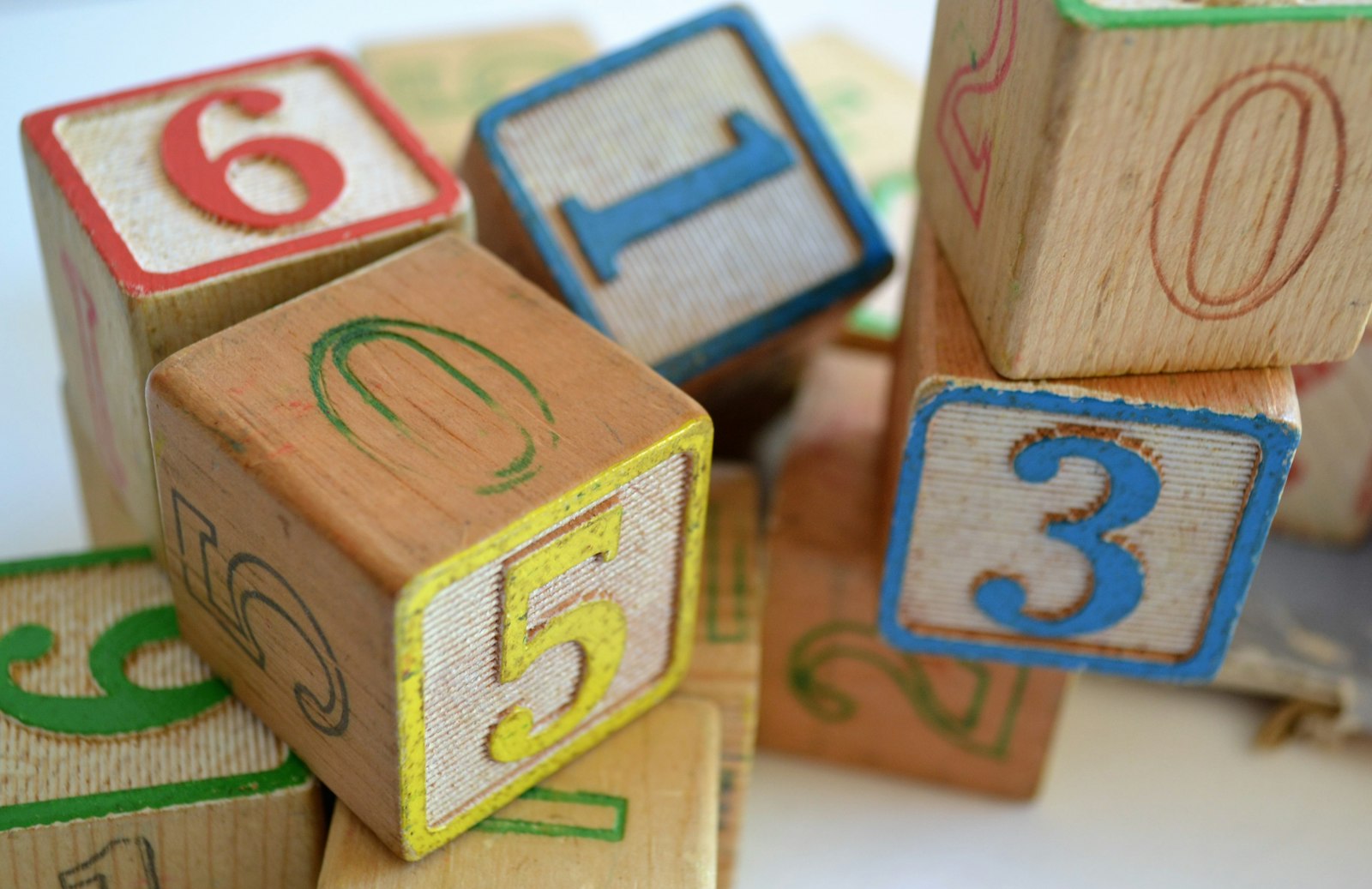
Using building blocks or sugar cubes, build a solid rectangular box (say, 3 across, 2 deep, 4 tall) and count every single cube. Then show that 3 × 2 × 4 gives the exact same number. The formula stops being a rule to memorise once a child has counted the cubes themselves and watched the multiplication match.
Say "cubic" out loud every time a volume answer is given
A volume answer without its unit — "24" instead of "24 cm³" — is an incomplete answer, and saying the word "cubic" out loud each time builds the habit of remembering why: the answer is counting cube-shaped units, not flat squares or plain lengths.
Multiply two dimensions first, then the third, rather than all three at once
For 4 × 3 × 2, work out the area of the base first (4 × 3 = 12 — the number of cubes in one flat layer), then multiply by the height (12 × 2 = 24 — the number of layers stacked up). Splitting it into "one layer, then how many layers" prevents the mental-maths slip that happens when trying to multiply three numbers in one step.
Estimate the size of the answer before calculating it
Before working out 8 × 5 × 3, ask "roughly how big should that be?" — a volume for a box this size should land somewhere around 100–150, not 16 or 1,000. An estimate that is wildly off after the real calculation is usually a sign that one of the three numbers was mistyped or a step was skipped.
Why the answer is measured in cubic units, not square units
A length measures a distance — a plain unit, like 5 cm. An area measures a flat surface — a square unit, like 20 cm², because it is counting how many 1 cm × 1 cm squares tile the surface. A volume measures a solid space — a cubic unit, like 24 cm³, because it is counting how many 1 cm × 1 cm × 1 cm cubes fill the solid. Each step up (length, then area, then volume) adds one more dimension being multiplied, and the unit changes to match exactly what is being counted.
A child who writes "24 cm" or "24 cm²" for a volume answer has not made an arithmetic mistake — the multiplication itself may be entirely correct. The error is in the unit, and it is worth treating as seriously as a wrong number, since it shows the formula was used without understanding what it measures.
A worked example: a fish tank 40 cm long, 20 cm wide and 25 cm tall
First, the base: 40 cm × 20 cm = 800 cm² — this is the area of the rectangle the tank stands on, and it is also how many unit cubes fit in a single 1 cm-tall layer of the tank. Then, the height: the tank is 25 cm tall, so there are 25 of those layers stacked on top of each other.
Multiplying the two: 800 × 25 = 20,000 cm³. That is the volume of the tank — 20,000 cubic centimetres of water it can hold, which not coincidentally equals 20 litres, since 1 litre is defined as exactly 1,000 cm³. Working the problem this way (base area, then × height) rather than all three numbers at once makes each step checkable on its own.
The mistake that causes most wrong answers: multiplying only two of the three dimensions
The single most common error is finding the area of one face of the box (say, length × width) and stopping there, forgetting the height entirely — especially when a diagram only clearly labels two of the three measurements and the third has to be read off a less obvious part of the drawing. The result looks like a completely plausible number, which is exactly what makes it easy to miss.
The fix is the estimate step above: a volume for a reasonably sized box should generally be a noticeably bigger number than its area, since it has one more multiplication in it. An answer that looks suspiciously close in size to what the area alone would be is worth checking against the original three measurements before it is written down as final.
Signs it’s time for outside help
When home help has done what it can
- Multiplies only two of the three dimensions and stops, especially when the third is drawn less clearly.
- Writes a volume answer in plain or square units instead of cubic units.
- Cannot explain what the answer to a volume calculation actually represents.
- Gets area and volume formulas mixed up when a problem shows a picture of a box.
- Struggles specifically with the three-number multiplication itself, independent of understanding what volume means.
Questions parents ask
FAQ
What age do children usually learn to find the volume of a rectangular prism?
This is usually introduced around ages 10–12 (US Grade 5, UK Key Stage 2 upper years, Australian Year 6), generally a year or two after area and perimeter are secure.
Why is the formula length × width × height, and not something else?
Length × width gives the area of the base — how many unit cubes fit in one flat layer. Multiplying by height gives how many of those layers are stacked to make the full solid. The formula is really "cubes per layer, times number of layers", just written as one multiplication.
Does it matter which side is called length, width or height?
No — multiplication can be done in any order and gives the same answer, so length × width × height, width × height × length, and every other order of the same three numbers all produce the identical volume.
What is the difference between volume and capacity?
Volume is a measurement of space, usually in cubic units (cm³); capacity is how much a container can hold, usually in litres or millilitres. For water and most everyday liquids the numbers convert directly (1 cm³ = 1 mL), which is why a tank's volume in cm³ and its capacity in litres describe the same fish tank.
Further reading
Classes that fit
Live, 60 minutes, four learners at most or 1-on-1.


Not sure which is right for your child?
Tell us their age and what they have tried so far, and we will suggest where to start before you book anything.