
Parent guide · 7 min read
Year 6 maths help: fractions, decimals and getting ready for high school
Year 6 is the last year of primary school, and the maths in it is doing two jobs at once: finishing the work on fractions, decimals and percentages that began in earlier years, and quietly introducing the ideas that Year 7 will lean on, such as negative numbers and unknown values. Children who coasted on quick mental arithmetic in Year 4 often meet their first real wobble here, because the questions stop being about fast answers and start being about connecting numbers, fractions and decimals to each other. This guide sets out what Year 6 usually covers, where the sticking points are, and what a parent can practise at home.
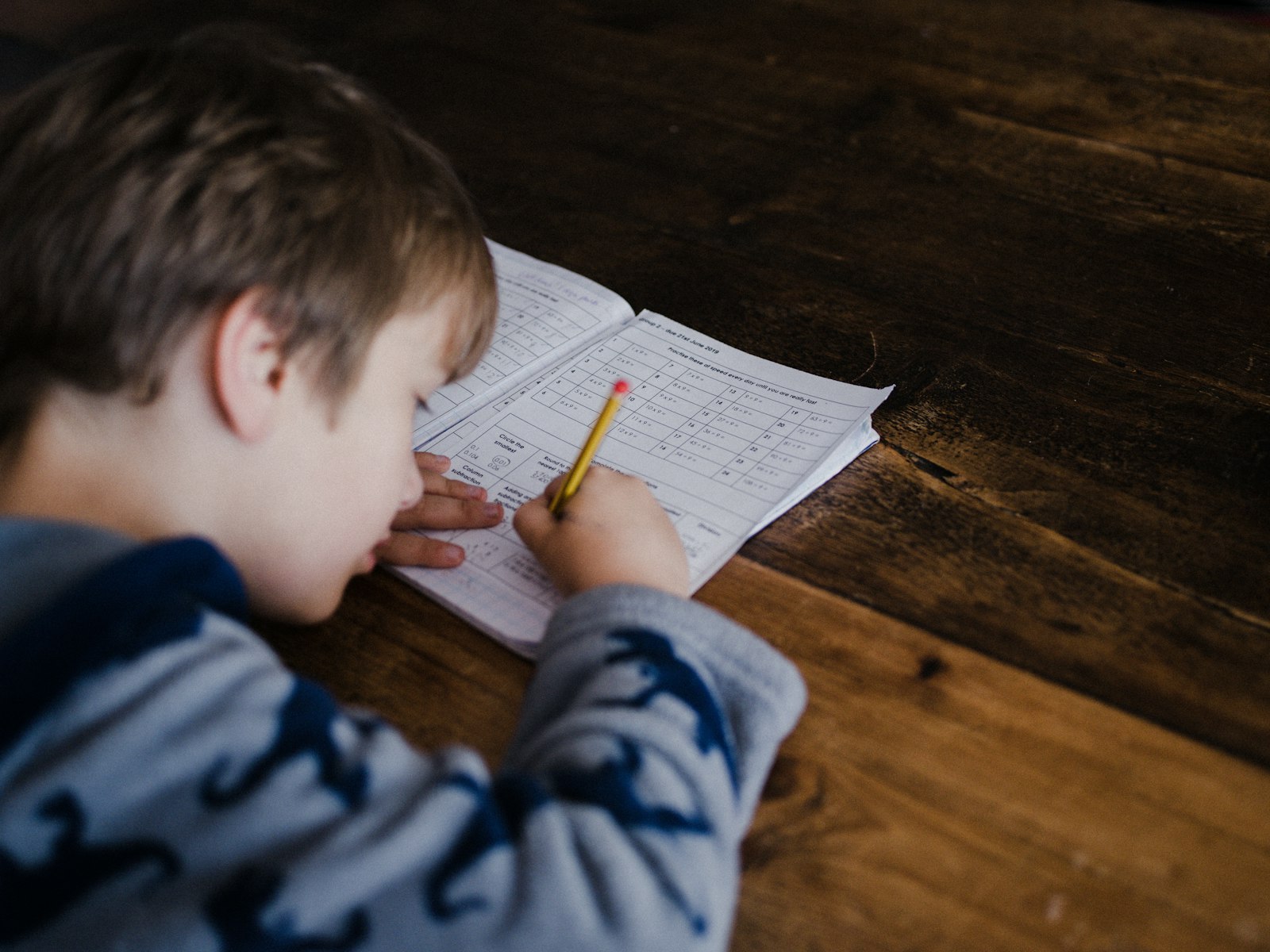
Try this tonight
5 things you can do at home
Pick a value and write it three ways
Choose 3/4 and ask your child to write it as a decimal and as a percentage, then do the same with 1/5 and 2/5. If they can only do the ones they have memorised, ask them to explain the method, for example dividing the top of the fraction by the bottom.
Add two fractions with different denominators, and ask why
Try 1/3 + 1/4. Ask what has to be true before the pieces can be added. The answer you want is that the pieces must be the same size first (twelfths here), not a rule about "finding the common number".
Draw a number line from −5 to 5 and ask for the order
Ask which is bigger, −2 or −4, and what is 3 less than 1. A child who thinks −4 is bigger than −2 is reading the digit and ignoring the sign, which is the exact slip that causes trouble in Year 7.
Set a decimal times-and-divide check with money
Ask what four items at $2.35 cost, then how much each person pays if $9.60 is shared by three. Money gives a child a reason to line up decimal places and a way to tell when an answer is unreasonable.
Ask them to explain one word problem aloud before solving it
Have your child say what the question asks, which numbers matter, and which operation they will use and why. Errors in Year 6 word problems are usually reading errors rather than calculation errors, and saying it aloud makes them visible.
What Year 6 maths usually covers
The Australian Curriculum for Year 6 sits across number, algebra, measurement, space, statistics and probability. In number, children work with all four operations on whole numbers, fractions and decimals, connect fractions, decimals and percentages, and meet negative numbers on a number line. In measurement and space they work with area, volume, angles and the coordinate plane, and in statistics and probability they interpret data displays and describe chance.
Exact order and emphasis differ between schools and states, so check your child’s term plan or ask the teacher which strand is current. The part to take seriously is the number work: it is the part Year 7 builds on directly, and it is the part where small gaps grow.
Why fractions, decimals and percentages feel like three topics
Many children first meet fractions in pizza slices, decimals in money and percentages in shop discounts, and each arrives with its own vocabulary and its own tricks. By Year 6 the curriculum expects a child to move freely between them, and a child who has kept them in separate boxes will answer "which is bigger, 0.6 or 5/8?" by guessing.
The fix is to keep returning to the same few friendly values, such as halves, quarters, fifths, tenths and eighths, and to write each in all three forms until the connections feel automatic. Percent just means "out of 100", so 3/5 = 60/100 = 0.60 = 60%. Once those anchor values are solid, harder conversions have something to hang on.
A worked example: adding fractions with different denominators
Take 2/3 + 1/4. A common wrong answer is 3/7, from adding the tops and adding the bottoms. The reason it fails: thirds and quarters are different-sized pieces, and you cannot count them together until they are cut to the same size.
Find a size both fit into: 12 works, because 3 × 4 = 12. Rewrite 2/3 as 8/12 (multiply top and bottom by 4) and 1/4 as 3/12 (multiply top and bottom by 3). Now the pieces match, so 8/12 + 3/12 = 11/12. A quick sense check: 2/3 is a bit more than a half and 1/4 is a quarter, so the total should be a bit more than three quarters but less than 1, and 11/12 fits.
Negative numbers and the first steps toward algebra
Year 6 is where many children first treat negative numbers as numbers they can order and calculate with, and where they begin to find an unknown in a simple number sentence, such as 7 + □ = 12. Neither is difficult on its own, but both are used constantly in Year 7, and a child who has only ever met them as a thermometer picture or a puzzle box will find the jump sudden.
At home, use a number line for the first and plain language for the second. "What number do I add to 7 to get 12?" and "7 + □ = 12" are the same question, and showing that the two are linked makes the later move to letters feel like a change of notation, not a new subject.
Signs it’s time for outside help
When home help has done what it can
- Cannot say which of a fraction, a decimal and a percentage is larger without converting by a memorised trick.
- Adds the numerators and the denominators when adding fractions.
- Gets decimal answers a factor of ten out, and does not notice the answer is unreasonable.
- Says −4 is larger than −2.
- Understands a word problem when it is read aloud but picks the wrong operation when reading it alone.
- Maths homework regularly ends in tears or avoidance, even on topics that were fine last term.
Questions parents ask
FAQ
What topics are in Year 6 maths in Australia?
The Australian Curriculum covers number (operations with whole numbers, fractions and decimals, percentages, negative numbers), algebra (finding unknown values), measurement (area, volume, time, angles), space (the coordinate plane and transformations), and statistics and probability. Each state and school sequences the topics a little differently.
Is it normal for a Year 6 child to struggle with fractions?
Yes. Fractions are one of the most common sticking points across primary school, and Year 6 asks more of them by mixing them with decimals and percentages. Struggling is usually a sign of a missing connection between ideas, not a lack of ability.
How much should my Year 6 child practise at home?
Short and regular beats long and occasional. Ten to fifteen minutes a few times a week on one specific skill, such as converting a fraction to a decimal, usually does more than a long weekend session on mixed worksheets.
Does Year 6 maths matter for high school?
Yes, particularly fractions, decimals, percentages and negative numbers. Year 7 builds algebra and ratio directly on those skills and does not usually re-teach them from scratch.
Further reading
Classes that fit
Live, 50–60 minutes, four learners at most or 1-on-1.
Not sure which is right for your child?
Tell us their age and what they have tried so far, and we will suggest where to start before you book anything.