
Parent guide · 7 min read
Types of angles for kids: telling acute, obtuse and right apart on sight
An angle is just an amount of turn, and most of the trouble with naming one starts because a child is looking at how long the two lines are, not at how far apart they have opened. A short, stubby angle can be wide (obtuse) and a long, thin-looking one can be narrow (acute) — the line length is a red herring the drawing constantly puts in front of them. Once "amount of turn" replaces "how it looks", sorting angles into their four common types becomes a fast, reliable check rather than a guess.
Try this tonight
4 things you can do at home
Use the corner of a piece of paper as a portable right angle
Any rectangular piece of paper has a real 90° corner built in. Holding it up against a drawn angle instantly shows whether the angle is smaller (acute), the same (right), or bigger (obtuse) — no protractor, no guessing from how the angle "looks".
Sort a mixed set of angles into four piles before naming any of them
Draw or print eight to ten angles of different sizes and openings. Have your child sort them into four piles — acute, right, obtuse, straight — using only the paper-corner check, before ever writing a label. Sorting first, naming second, breaks the habit of guessing a name from a glance.
Rotate one arm of a hinge or a pair of scissors slowly, and call out the type as it changes
Open a pair of safety scissors (or two straws taped at one end) from fully closed to fully open, pausing every so often to name the angle: acute, then right, then obtuse, then straight at fully open. Watching one angle grow through every type in order fixes the order permanently, in a way that four separate static pictures do not.
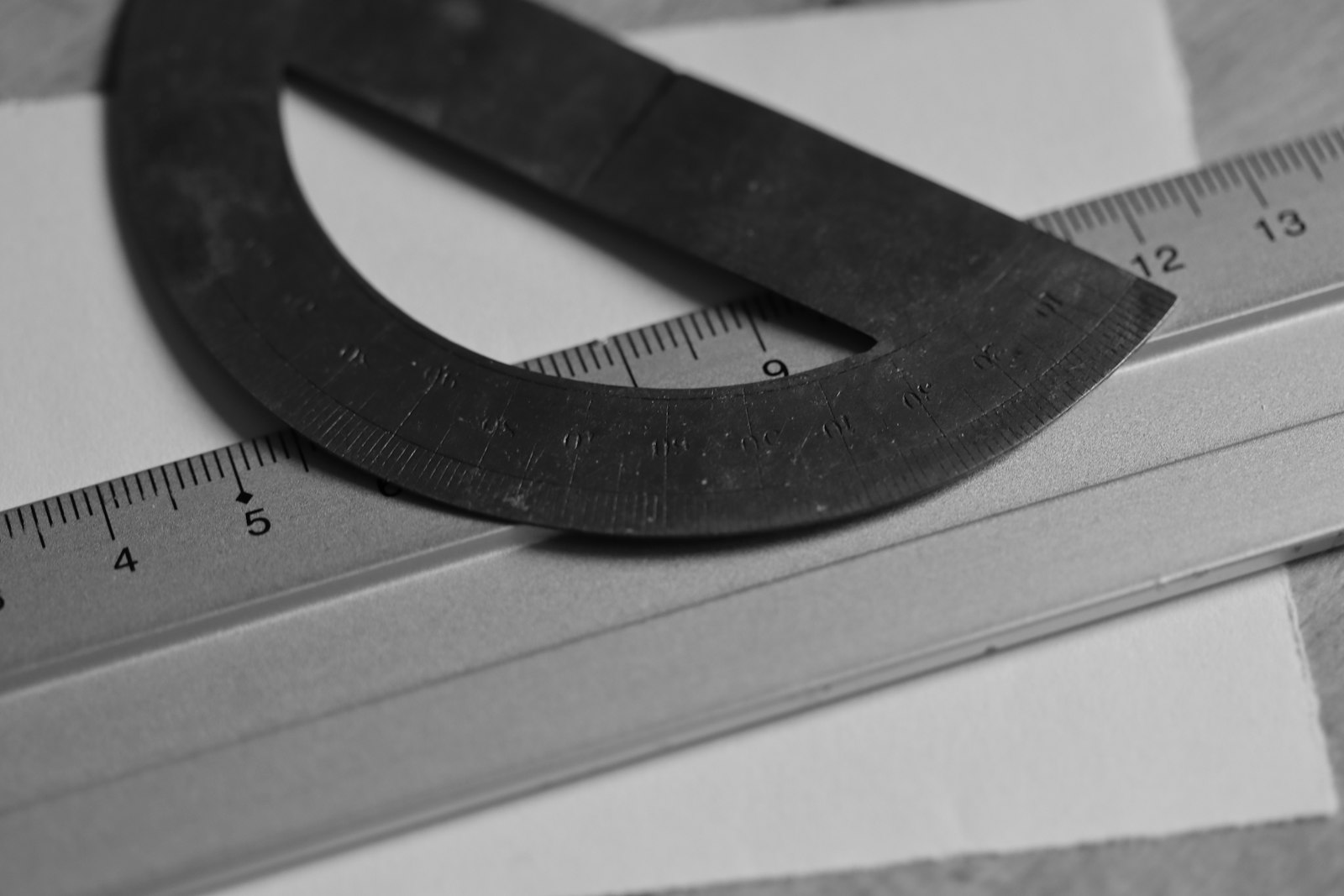
Read a protractor from the correct number scale
A protractor has two rows of numbers running in opposite directions. Before reading a measurement off it, first estimate roughly which type the angle looks like (acute, right or obtuse) — if the angle looks obtuse but the number read looks like 50°, the wrong scale was used, and that estimate is what catches the error.
Why line length is not part of the answer
An angle measures how far one line has turned away from another around a shared point — nothing about how long either line is drawn. Two angles with completely different arm lengths can be exactly the same size, and two angles with identical arm lengths can be completely different sizes. A child who has not had this said explicitly will often judge an angle "big" because the lines are long, which gets the classification wrong on paper even when the underlying idea (amount of turn) is understood.
This is why the paper-corner check works better than eyeballing: it removes line length from the comparison entirely and leaves only the amount of opening, which is the actual thing being measured.
A worked example: naming and measuring a 130° angle
Start with the paper-corner check: hold the 90° corner against the angle. If the drawn angle opens further than the paper corner but has not opened all the way flat, it is obtuse — somewhere between 90° and 180°. That estimate alone (obtuse, so the number should land between 90 and 180) is worth doing before ever touching a protractor.
Now measure it: line up the protractor's centre point exactly on the angle's vertex, with the 0° line on one of the two arms. Read the scale that starts at 0° on that same arm — for an obtuse angle, that reading will be a number bigger than 90, in this case 130°. If the other scale is read by mistake, it gives 50°, which the earlier estimate (obtuse, so more than 90) should already have flagged as wrong.
Straight and reflex angles: the two types worksheets often skip
A straight angle is exactly 180° — visually, it is just a straight line, which is why children often do not think of it as an "angle" at all until it is pointed out directly. A reflex angle is bigger than a straight angle: anything between 180° and 360°, the "long way round" turn on the outside of a smaller angle.
Reflex angles trip children up specifically because most practice only ever shows the smaller of the two angles at a point, so the idea that an angle can be bigger than a straight line rarely gets practised. A clock face is a useful real check: the angle from 12 to 4 is acute or obtuse depending on exactly where the hands sit, but the angle measured "the other way round," from 4 back to 12 going past 8, is reflex.
Signs it’s time for outside help
When home help has done what it can
- Judges an angle as "big" or "small" based on how long its two lines are drawn, not how far apart they have opened.
- Calls every angle that is not obviously a right angle "acute", without checking against a square corner.
- Reads a protractor measurement from the wrong one of its two number scales.
- Cannot say what a straight angle is, even though it can point to and name a right angle correctly.
- Gets confused by reflex angles, or does not know they exist as their own category.
- Can sort printed angles correctly but freezes when asked to estimate an angle's type with no protractor at hand.
Questions parents ask
FAQ
What age do children usually learn to classify angles by type?
This is usually introduced around ages 8–10 (US Grade 4, UK Key Stage 2, Australian Year 4), with protractor measurement typically following a year or so later once the four basic types are secure.
What is the easiest way to check an angle type without a protractor?
Hold the square corner of any rectangular piece of paper against the angle. If the angle is smaller than the paper corner it is acute, the same size it is a right angle, and bigger (but not a straight line) it is obtuse.
Why does my child keep reading the wrong number off the protractor?
A protractor has two scales running in opposite directions, and it is easy to read the one that starts on the wrong side. Estimating the angle's type first — acute, right or obtuse — before reading the number catches this, because an obtuse angle can never have a correct reading under 90°.
Is a reflex angle just a "big obtuse angle"?
No — they are separate categories with a hard boundary at 180°. An obtuse angle is always between 90° and 180°; a reflex angle is always bigger than 180°, up to (but not including) 360°. Nothing is ever both.
Do the four angle types matter for anything beyond naming them on a worksheet?
Yes — angle types are the foundation for classifying triangles and other shapes by their angles, for understanding why a straight line always measures 180°, and later for the geometry proofs and coordinate work that build directly on knowing an angle's type at a glance.
Further reading
Classes that fit
Live, 60 minutes, four learners at most or 1-on-1.
Not sure which is right for your child?
Tell us their age and what they have tried so far, and we will suggest where to start before you book anything.