
Parent guide · 6 min read
What is a function? A plain-language guide for parents
A function is one of those words that sounds harder than the idea behind it. A function is a rule that takes an input and gives back exactly one output. A vending machine is a function: press B3 and you always get the same snack. The trouble starts when the idea meets new notation, such as f(x) = 2x + 3, and a child who understood the machine suddenly sees a wall of letters. Most of what helps is going back and forth between the rule, a table of values and a graph until all three feel like the same thing.
Try this tonight
5 things you can do at home
Start with a machine, not a formula
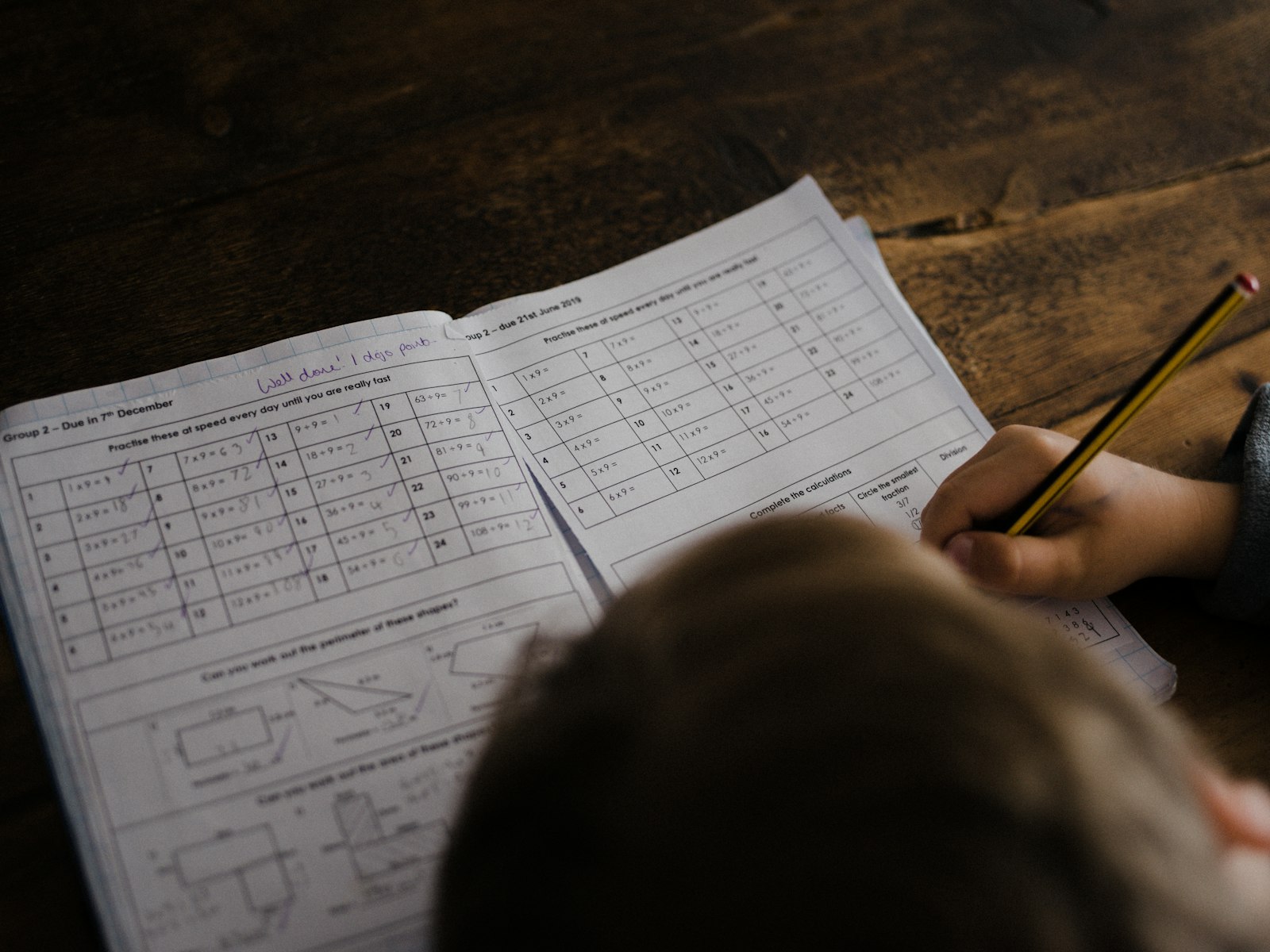
Ask your child to describe a rule in words: "double it, then add 3". Say a number, have them give the output, and write the pairs in a two-column table. Doing this with five or six inputs makes the rule visible before any letters appear.
Turn the words into a formula
Let x stand for the input and write what happens to it: 2x + 3. Then check the formula against two rows of the table. If the formula and the table disagree, the child has found a useful mistake in either the words or the symbols.
Learn to read f(x) out loud
Say "f of 4" and write "put 4 in". If f(x) = 2x + 3, then f(4) = 2 × 4 + 3 = 11. Repeating this with two or three different inputs, including 0 and a negative number, builds the habit of replacing x everywhere it appears.
Ask the one test question
For any table or set of pairs, ask: does any input appear twice with different outputs? If yes, it is not a function. This question works on a table, on a list of pairs and on a graph, so it is worth asking every time.
Use one real-life function a week
A taxi fare, a phone plan or the cost of tickets all work: cost depends on the number. Have your child write the rule, build a small table and say what the input and output are. Linking the idea to money or distance keeps it from becoming only symbols.
Input, rule, output: what "exactly one" really means
The words "exactly one output" are the heart of the definition. Each input must have an answer, and that answer must be just one. Different inputs are allowed to share an output. The rule y = x² sends both 2 and −2 to 4, and that is perfectly fine, because each input still has only one answer.
Compare two lists of pairs. List A is (1, 3), (2, 5), (3, 7). List B is (1, 4), (1, 6), (2, 8). List A is a function: every input has one output, and the rule is y = 2x + 1. List B is not, because the input 1 gives both 4 and 6. A child who remembers "an input cannot have two answers" can tell these apart in seconds.
Worked example: reading and using f(x) notation
Suppose a taxi charges a $3 starting fee plus $2 for each kilometre. If the distance is d kilometres, the fare is f(d) = 3 + 2d. To find the fare for a 5 km trip, put 5 in: f(5) = 3 + 2 × 5 = 13, so the fare is $13. For 0 km the fare is f(0) = 3, which is the starting fee, and that tells a child what the 3 in the formula means.
Now try g(x) = x² + 1. Then g(3) = 3² + 1 = 10, and g(−2) = (−2)² + 1 = 5. Notice that f(x) does not mean f multiplied by x. It is the name of the rule, written with its input in brackets. A child who treats f(x) as a product will try to cancel or multiply the f, so it is worth saying this out loud once.
The vertical line test, and when a graph is not a function
On a graph, the question "does an input have two outputs?" becomes "can a vertical line touch the curve in two places?". If any vertical line crosses the graph twice, then one x-value has two y-values, and the graph is not a function. A straight sloping line passes the test, and so does a parabola opening up or down.
A circle fails it. For the circle x² + y² = 25, the input x = 3 gives y = 4 and also y = −4, so one input has two outputs. This is a good example to draw once on paper, because it shows that "not a function" does not mean "wrong" or "broken". It simply means the relationship cannot be written as one rule with one answer.
Signs it’s time for outside help
When home help has done what it can
- Reads f(x) as f times x and tries to multiply or cancel it.
- Can follow a table of values but cannot write the rule behind it.
- Says a relationship is not a function because the answer repeats, rather than because an input has two answers.
- Forgets to replace x everywhere when substituting, for example in x² + x.
- Makes sign slips with negative inputs such as f(−2).
- Can do a worksheet of f(x) questions but cannot explain what the numbers mean in a real situation.
Questions parents ask
FAQ
What age do children learn about functions?
The idea of a rule with inputs and outputs shows up informally from around age 9 or 10, while formal function notation and the definition usually arrive around ages 13–14 (US Grade 8, Australian Years 8–9) and are built on through high school.
Is every equation a function?
No. y = 2x + 1 is a function, because each x gives one y. The equation x² + y² = 25 is not, because one x can give two y-values. Many everyday equations in school are functions, so the exceptions are worth meeting once and then remembering.
Can two different inputs have the same output?
Yes. In y = x², both 2 and −2 give 4. The rule only forbids one input giving two different outputs, so the two-to-one case is allowed.
What is the difference between f(x) and y?
For most school work they mean the same thing: y = 2x + 3 and f(x) = 2x + 3 describe the same rule. The f(x) form is useful because it names the rule and lets you write f(4) to mean "the output when the input is 4".
Classes that fit
Live, 50–60 minutes, four learners at most or 1-on-1.
Not sure which is right for your child?
Tell us their age and what they have tried so far, and we will suggest where to start before you book anything.