
Parent guide · 6 min read
Similar triangles for kids: how to tell and how to find a missing side
Two triangles are similar when they have exactly the same shape but may be different sizes: one is an enlarged or shrunk copy of the other, possibly turned or flipped. Children meet this idea around Grade 8 (age 13–14), and it comes back in high school geometry and trigonometry. The questions look intimidating, with labels like VUW and VXY, but they almost all reduce to two skills: deciding whether the triangles are similar, and using the scale factor to find a missing side. This guide shows both with worked numbers.
Try this tonight
4 things you can do at home
Cut out two triangles that are copies at different sizes
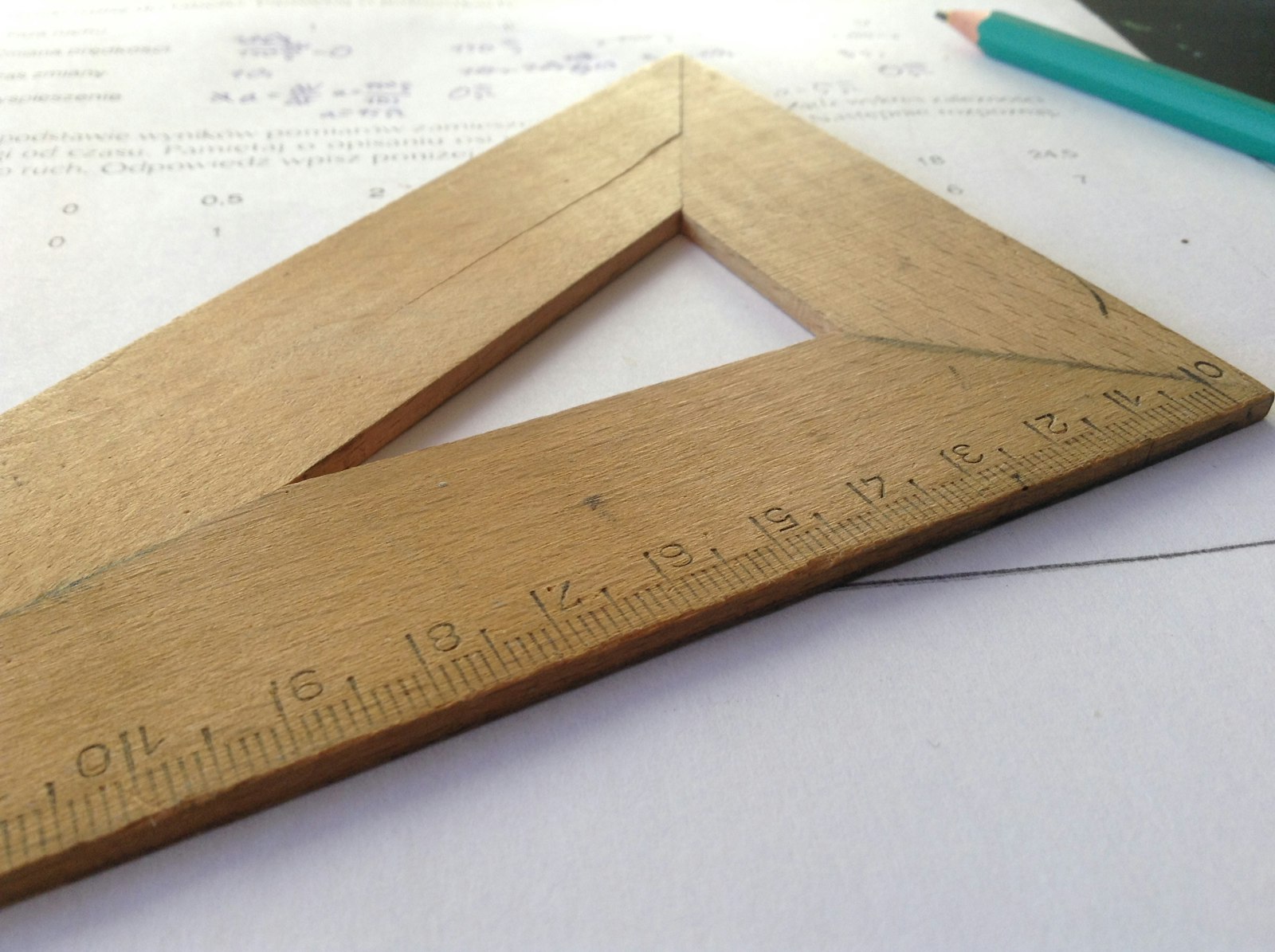
Draw a 3-4-5 triangle on squared paper, then a 6-8-10 one. Lay them side by side and have your child compare the angles (they look the same) and the sides (each in the second is double the first). This is the whole idea in one picture.
Colour the matching angles before doing any sums
In any question, give the equal angles the same colour. The sides opposite the same colour are corresponding sides. Doing this first prevents the most common slip, which is pairing sides that are not actually matched.
Write the scale factor as a fraction with the units in the right order
If the small triangle has a side 3 and the big one has the matching side 9, the scale factor from small to big is 9 ÷ 3 = 3. Have your child say aloud "small to big" or "big to small" so they do not flip it halfway through.
Check the answer for sense
If the second triangle is larger, the missing side must come out larger than its partner. A quick "does this make sense?" catches a mistake of multiplying when they should have divided.
What "similar" means (and how it differs from "congruent")
Congruent triangles are identical in both shape and size: you could place one exactly on top of the other. Similar triangles share only the shape. All their matching angles are equal, and their matching sides are in the same ratio. Every pair of congruent triangles is similar, with a scale factor of 1, but most similar triangles are not congruent.
The angle test is the most useful rule at this age. If two angles of one triangle equal two angles of another, the third angles must also be equal because angles in a triangle add to 180°, so the triangles are similar. Children rarely need to check all three.
A worked example: deciding whether triangles are similar
Triangle ABC has angles 50° and 60°. Triangle DEF has angles 60° and 70°. The third angle of ABC is 180° − 50° − 60° = 70°, so ABC has 50°, 60° and 70°. DEF has a third angle of 180° − 60° − 70° = 50°. Both triangles have angles 50°, 60° and 70°, so they are similar.
Now change DEF to 55° and 70°. Its third angle is 55°, so the angles are 55°, 55° and 70°, which does not match ABC. The triangles are not similar. A sensible written answer names the test: "Two angles are equal, so the triangles are similar".
A worked example: finding a missing side
Triangle PQR is similar to triangle XYZ. PQ = 4 cm matches XY = 10 cm. QR = 6 cm matches YZ, which is unknown. The scale factor from small to big is 10 ÷ 4 = 2.5. So YZ = 6 × 2.5 = 15 cm.
You can also set this up as a proportion: 4/10 = 6/YZ. Cross-multiplying gives 4 × YZ = 60, so YZ = 15. Both methods give the same answer. Choose whichever your child finds steadier, and make sure the same triangle is on top of both fractions.
Where similar triangles show up later
The idea reaches well beyond the textbook. A shadow on the ground and the object that casts it form similar triangles, which is how you can find the height of a tree from a metre stick. The slope of a line is constant for the same reason, which is why similar triangles are used to explain slope in Grade 8. In high school, trigonometry ratios such as sine and cosine are built on similar right triangles.
Signs it’s time for outside help
When home help has done what it can
- Matches sides by their position on the page instead of by the angles they sit opposite.
- Multiplies when they should divide, so the "bigger" triangle ends up with the smaller side.
- Says triangles are similar because they "look the same" without checking angles or ratios.
- Mixes up similar with congruent, or does not know the difference.
- Gets stuck when one triangle is rotated or flipped relative to the other.
Questions parents ask
FAQ
What grade do children learn similar triangles?
In the US Common Core, similarity is introduced in Grade 8 (ages 13–14) and developed in high school geometry. In Australia it is taught in the middle secondary years, so check your child’s year level in the Australian Curriculum.
What is the difference between similar and congruent triangles?
Congruent triangles have the same shape and the same size. Similar triangles have the same shape but can differ in size. Congruent triangles are a special case of similar ones with a scale factor of 1.
Do all three angles have to be checked?
No. Because the angles in a triangle always add to 180°, two matching angles force the third to match too. Checking two is enough.
Are the sides equal in similar triangles?
No. The matching sides are in the same ratio (the scale factor), not equal. They are equal only when the triangles are congruent.
How do I help with a homework question that has labelled vertices?
Have your child list corresponding vertices in order, such as A matches D, B matches E, C matches F. The order of the letters in the name of each triangle tells you which sides match.
Further reading
Classes that fit
Live, 50–55 minutes, four learners at most or 1-on-1.
Not sure which is right for your child?
Tell us their age and what they have tried so far, and we will suggest where to start before you book anything.