
Parent guide · 7 min read
What does an AI coding class for kids actually teach?
Parents hear "AI" everywhere and wonder what a children’s class could possibly teach about it. The honest answer is not chatbots or magic. It is one idea: instead of writing every rule by hand, a program can look at examples and work out a rule for itself. Children can understand that idea, try it with a handful of numbers, and see where it goes wrong. This guide explains what is worth learning at ages 8 to 16, shows a worked example you can do on paper, and lists what to look for in a class.
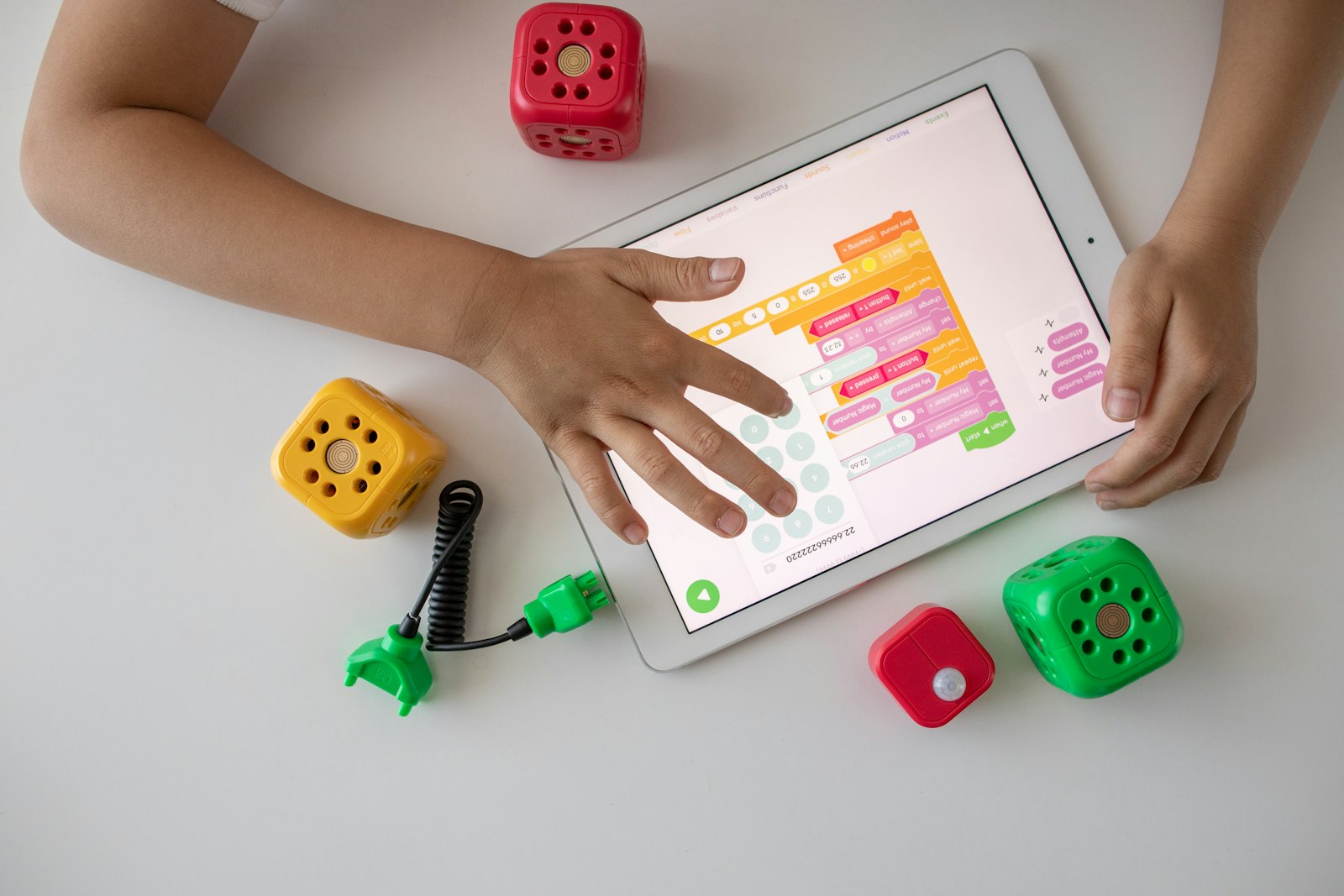
Try this tonight
5 things you can do at home
Ask your child how a program could tell cats from dogs
Let them come up with rules ("pointy ears", "size") and then find a photo that breaks each rule. This is exactly the problem that makes learning from examples useful, and it takes five minutes and no computer.
Play with a "teach the computer" website together
Free browser demos let a child show a camera or a drawing a few examples and watch the computer guess. Ask "what did you show it, and why did it get that one wrong?" The question matters more than the toy.
Sort a small set of examples by hand
Put 6 to 8 fruits, animals or coins in two labelled groups using two measurements, such as weight and how bumpy the skin is. Then add a new item and ask which group it belongs in, and why. That is classification, the most common first machine learning task.
Check the prerequisite: can they read simple Python?
Variables, lists and loops are enough. If those are shaky, spend a few weeks on them first; the AI ideas are easy to follow, but the code is not if the basics are missing.
Talk about mistakes and fairness
Ask "what if the examples were all photos of one kind of dog?" Children grasp quickly that a model trained on narrow examples gives narrow answers. It is the most important thing a class can leave them with.
Rules versus learning from examples
Ordinary programming is rule-writing: if the temperature is over 30, print "hot". Machine learning turns this around. The programmer supplies examples with the right answers (for instance, thousands of labelled photos) and the program works out a rule that fits them. The examples are called training data, the right answers are labels and the rule it finds is the model.
This is the first of the "big ideas" listed in the AI4K12 guidelines for schools: computers perceive the world using sensors, and learning from data is how they get better at it. For children the point is simply that the quality of the answer depends on the quality of the examples.
What a class can realistically cover at ages 8 to 16
Children cannot build a modern chatbot, and a class that promises that is overselling. What they can do is build small models on small data: sort items into groups, predict a number from a pattern, or recognise simple shapes. They can also learn the vocabulary (data, label, training, testing, prediction) and the habit of testing a model on examples it has never seen.
Younger children (about 8 to 11) usually work on the ideas with hand-sized datasets and short Python programs. Teenagers can go further with numbers, graphs and measuring how often the model is right. The skills overlap heavily with ordinary Python, so a child who is comfortable with variables, lists and loops is ready.
Worked example: a nearest-neighbour guess, by hand
Suppose we have four fruits, each with a weight in grams and a skin score from 1 (smooth) to 5 (bumpy). Apples: (150 g, 1) and (170 g, 1). Oranges: (140 g, 4) and (160 g, 5). A new fruit weighs 155 g and has a skin score of 4. Which is it?
Measure how far the new fruit is from each known one, adding the weight difference and the skin difference. From the apple (150, 1): 5 + 3 = 8. From the apple (170, 1): 15 + 3 = 18. From the orange (140, 4): 15 + 0 = 15. From the orange (160, 5): 5 + 1 = 6. The closest is the orange at 6, so the guess is "orange". A program does exactly this sum, just faster and with more examples.
Two lessons come out of it. First, it is only a guess: add a lumpy 155 g apple to the data and the answer could change. Second, which measurements you choose, and how you scale them, changes the result. Both are real concerns for professional models, shown here in a form a ten-year-old can check with a pencil.
What to look for in a class, and what to be wary of
Look for projects where the child trains something small and tests it, and for time spent on why a model got an answer wrong. Be wary of anything that only has children type prompts into someone else’s chatbot, or that promises a robot or a career. Using an AI tool and understanding how a model learns are different skills; the second is the one that lasts.
Also check what coding comes first. Machine learning code leans on lists, loops and functions, so a class that assumes none of them will either rush or leave a beginner behind.
Signs it’s time for outside help
When home help has done what it can
- Keeps asking how chatbots, recommendations or photo filters "know" things.
- Already writes short Python programs with variables, lists and loops.
- Enjoys finding patterns in numbers, sorting things or running small experiments.
- Uses AI tools at home or school and takes their answers as always correct.
- Has finished a beginner coding course and wants a project with a point.
Questions parents ask
FAQ
What is machine learning, in plain words?
It is a way of getting a program to find a rule from examples instead of being given the rule. You show it many labelled examples, it finds a pattern that fits them, and then it uses the pattern on new cases.
What age can a child start learning about AI?
The ideas (learning from examples, mistakes, fairness) can be introduced from about 8 with hand-sized examples. Writing the code usually needs some Python first, so many children start coding at 8 to 10 and reach AI projects a little later.
Does my child need to be good at maths?
Not for the first steps. Comparing numbers, adding differences and reading a simple graph are enough. Older children who enjoy maths can go deeper into how well a model performs.
Will they build something like ChatGPT?
No. Models like that need huge amounts of data and computing power. Children can build small models that learn simple patterns and understand the basic mechanism, which is what makes the larger systems less mysterious.
Should they learn to code before learning about AI?
Yes, a little. Variables, lists and loops are the minimum, because AI projects are written in code. The concepts can be discussed earlier, but the building needs the basics.
Further reading
Classes that fit
Live, 50–60 minutes, four learners at most or 1-on-1.
Not sure which is right for your child?
Tell us their age and what they have tried so far, and we will suggest where to start before you book anything.